


Belt

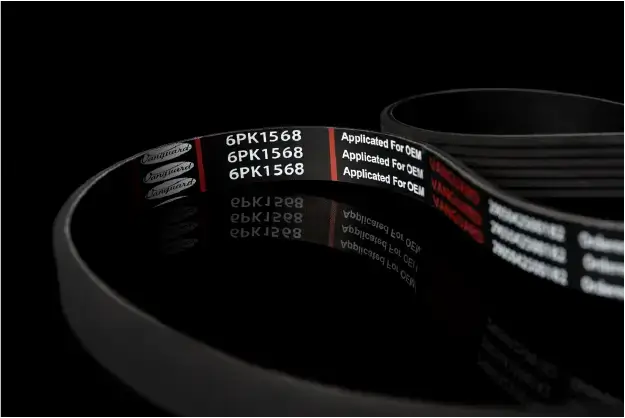
A belt is a loop of flexible material used to create a mechanical connection and transmit power between two or more shafts. Belts are wound around pulleys. In a system with two pulleys, both pulleys may rotate in the same direction or the belts may be crossed so that their directions are opposite. One of the cheapest ways to transmit power between shafts is with a belt. Power transmission by belt is less powerful than by gears and chains. Belts are usually measured in millimeters or inches, with millimeter belts measuring the outer diameter and inch belts measuring the inner diameter.
Material of automotive belts
- 1- CR (Chloroprene Rubber)
Chloroprene rubber or neoprene is a very useful synthetic rubber. Polychloroprene is the polymer name for the synthetic rubber known as neoprene. The rubber compounds are abrasion resistant. These compounds have high resistance to heat up to 90 degrees Celsius.
Polychloroprene rubber was first produced and marketed by the American company Dupont in 1931 and is considered one of the first commercially successful synthetic rubbers.
The company initially marketed this rubber under the name Duprene, but in 1939 it changed its name and chose the trade name Neoprene for it.
- 2- EPDM (Ethylene Propylene Diene Monomer)
It is a polymer that has many and varied applications in industries. In fact, it can be said that EPDM is a synthetic rubber that has high resistance. In the analysis of EPDM, it can be said that this copolymer material, which does not have unsaturated bonds, has many applications in the automotive and construction industries, because it has very high resistance and it can almost be said that it is used as a rubber insulator.
- 3- HNBR (Hydrogenated Nitrite Butadiene Rubber)
HNBR rubber is a type of NBR rubber that is saturated with hydrogen and its double bond is removed to make it resistant to ozone, this is a highly engineered and expensive rubber and is used for aerospace applications. HNBR rubber has better abrasion resistance. It is excellent with corrosion resistance, tensile, tear resistance, compression properties.